BounceZero Research - Data Study
By Ayoub Lebda, Founder
- Published July 13, 2026 - Dataset snapshot Q3-2026-preview - 7 min read
Key findings
- - We followed 826,000 addresses that were verified twice at different points in time - a natural experiment in how email ages.
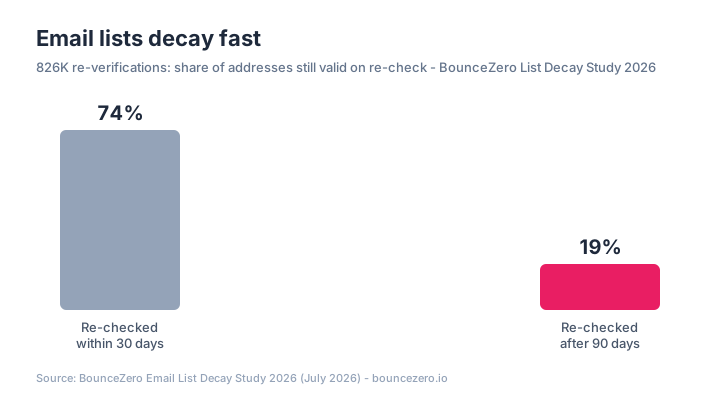
- - Of addresses verified valid and re-checked within 30 days, 74.3% were still valid.
- - Re-checked 31-90 days later, only 44.9% were still valid.
- - Re-checked more than 90 days later, only 19.2% were still valid - four in five had degraded.
- - The practical read: a validated list has a half-life measured in weeks, not years. Verifying once and reusing the result for a quarter is close to not verifying at all.
Why this is hard to measure - and how we did it
Almost everyone quotes a list-decay number ("lists degrade ~2% per month" is the usual figure),
and almost no one shows their work. The reason is that decay is genuinely hard to observe: to
measure it you need the same address verified at two different times, and most datasets
only ever see an address once. Our network does not have that limitation. Over five months we
re-verified hundreds of thousands of addresses as customers re-ran lists - which lets us watch
individual addresses age.
The method is deliberately simple. For every address hash seen at least twice, we took its
first classification and its last classification, and the number
of days between them. Then we asked one question: of the addresses that were valid the first
time, what share were still valid the second time? Grouping by the gap between checks turns
that into a decay curve.
The decay curve
Among addresses that were valid at first check, the share still valid at the
second check falls sharply and monotonically with elapsed time:
| Time since first check |
Addresses followed |
Still valid |
| Within 30 days |
116,690 |
74.3% |
| 31 to 90 days |
63,063 |
44.9% |
| More than 90 days |
83,265 |
19.2% |
Copy this stat: "Of email addresses verified valid and re-checked more than 90 days
later, only 19% were still valid - four in five had degraded." - BounceZero Research,
How Fast Does an Email List Decay? (bouncezero.io/email-list-decay-study-2026)
The shape matters more than any single number. Validity does not erode gently; it collapses. Three
quarters of a freshly cleaned list is still trustworthy a month later - but by the far side of a
quarter, four out of five of those once-good addresses can no longer be trusted without a fresh
check. The "clean list" you exported in January is a different, mostly-dead object by April.
What this means operationally
This is the entire case for verifying before each send, expressed as data rather
than as a sales pitch. A list verified once and reused across a quarter spends most of that quarter
carrying addresses that have silently gone bad - and every one of them is a bounce, and every
bounce is a small deposit into the reputation penalty that mailbox providers assess against your
sending domain. Reputation is slow to build and slow to repair; the addresses that damage it decay
in weeks. The two timescales do not match, and that mismatch is exactly where sender reputations
quietly die.
The senders who consistently reach the inbox are not the ones with permanently cleaner audiences.
They are the ones who re-verify close to send time, so the list they mail is the list as it exists
now - not as it existed the last time someone remembered to check.
Methodology
The dataset is 826,000 addresses verified two or more times by the BounceZero
network between February and July 2026, with at least one full day between the first and last
check. Each address is reduced to (first classification, last classification, gap in days); no
address content enters the analysis, and every cell reported here aggregates well above our
minimum-volume floor of 1,000 observations. The figures are frozen in the versioned snapshot
Q3-2026-preview and remain reproducible against it. "Valid" combines our
verified and likely-valid classifications; "degraded" means the address later
returned invalid, risky, complainer or spamtrap.
Limitations - read these before citing
This is observational data, not a controlled experiment, and it carries a real
selection bias that you should understand before quoting it. Addresses get
re-verified because a customer chose to re-run a list - and that choice is not random. A list
re-checked after 90 days may well have been re-checked because the sender suspected it had
aged. That means the absolute "still valid" percentages, especially in the longer buckets, are
likely pessimistic versus a hypothetical random re-sampling of all addresses.
We are publishing the numbers anyway, with the caveat attached, for two reasons. First, the
direction and monotonicity of the curve - validity falling steadily as time passes - is
robust to the bias; selection effects change the levels, not the slope. Second, the corpus is the
BounceZero verification network, which over-weights outbound prospecting lists; consumer-mailbox
and transactional-list decay may differ. The honest one-line summary is therefore directional:
the longer a validated address sits unchecked, the less likely it is to still be
valid - and the drop-off is steep, not gradual. How steep, exactly, for your specific
list, is a question only re-checking your own list can answer.