BounceZero Research - Data Study
By Ayoub Lebda, Founder
- Published July 13, 2026 - Dataset snapshot Q3-2026-preview - 8 min read
Key findings
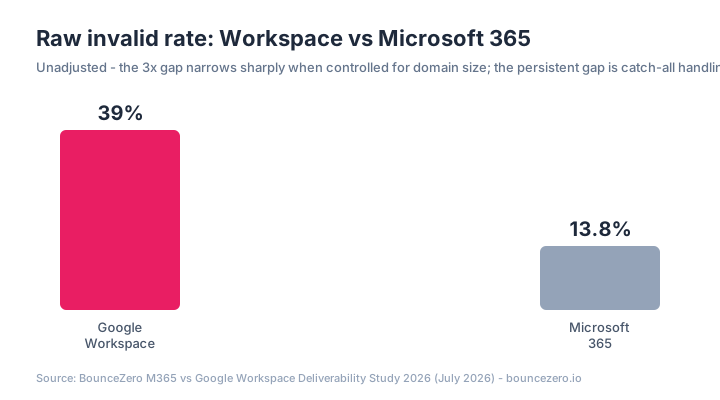
- - At face value, addresses on Google Workspace domains came back 39.0% invalid versus 13.8% on Microsoft 365 - an almost 3× gap.
- - The gap is mostly an artifact of who uses each. Restrict to established domains (20+ checks) and it collapses: 9.1% invalid on Workspace vs 10.9% on Microsoft 365. On like-for-like domains, the two are indistinguishable.
- - What genuinely differs is catch-all configuration: 22.9% of Workspace checks hit a catch-all domain versus 5.2% on Microsoft 365 - so on Workspace, the SMTP handshake alone can't judge nearly a quarter of addresses.
- - The operational takeaway: your recipient's provider is a signal about your list's composition, not about the provider's reliability - and it changes which verification method you can trust.
The gap everyone would quote
Split the corpus by the mail provider behind each recipient domain - detected from MX records -
and one comparison jumps out. Across 476,122 verifications on Microsoft 365 domains,
13.8% came back invalid. Across 96,987 verifications on Google Workspace domains,
39.0% came back invalid. Taken at face value, that is a headline: "emails to
Google Workspace addresses are three times as likely to be dead."
It would also be, as stated, misleading - and the interesting part of this study is why.
The gap that survives a control
The Workspace and Microsoft 365 populations in our corpus are not comparable. Microsoft 365 domains
averaged 5.1 checks per domain; Google Workspace domains averaged just
2.1. In an outbound-verification corpus, that difference is diagnostic: the
Workspace side is dominated by tiny, rarely-seen domains - the small businesses and one-person
startups that show up once or twice on a scraped prospecting list, exactly the domains where a
large fraction of the addresses were guessed rather than known.
So we controlled for it. Restrict both providers to established domains with at least 20
verifications - real organizations, not list-scraping noise - and the gap essentially
disappears:
| Invalid rate |
Microsoft 365 |
Google Workspace |
| All domains (face value) |
13.8% |
39.0% |
| Established domains (20+ checks) |
10.9% |
9.1% |
Copy this stat: "The 3× invalid-rate gap between Google Workspace and Microsoft 365
recipient domains vanishes once you control for domain size - 9.1% vs 10.9% on established domains.
The gap measures list composition, not provider quality." - BounceZero Research,
Microsoft 365 vs Google Workspace (bouncezero.io/microsoft365-vs-google-workspace-deliverability-2026)
On like-for-like domains, Workspace is if anything marginally cleaner. The surface gap was never
about Google versus Microsoft; it was about whose domains land on each - and small,
newly-seen Workspace domains on a cold list carry a lot of dead addresses regardless of who hosts
their mail.
The difference that is real: catch-all
One provider difference does survive every control, and it is the one that actually matters for how
you verify. 22.9% of Google Workspace checks landed on catch-all domains, versus 5.2% on
Microsoft 365 - Workspace makes catch-all routing trivial to configure, and a lot of small
domains leave it on. A catch-all domain accepts delivery for every address, real or not,
so the SMTP handshake returns "accepted" whether or not the mailbox exists.
That is a methodological fact with teeth: on nearly a quarter of Workspace domains, a plain
SMTP-probe verifier - the kind most free tools ship - physically cannot tell a real address from a
fabricated one. Judging those addresses requires a second layer: statistical and ML signals that
reason about the domain and the local-part rather than trusting the handshake. On Microsoft 365,
where catch-all is one address in twenty, the handshake carries far more of the load.
What senders should do with this
Two operational reads follow. First, treat the provider mix of your list as a quality
signal: a list heavy on tiny Google Workspace domains is usually a list heavy on guessed
addresses, and it will bounce accordingly - not because of Google, but because of how it was built.
Second, be skeptical of any verification result that doesn't distinguish catch-all as its
own risk tier. A tool that marks catch-all Workspace addresses "valid" is guessing; a tool
that marks them all "invalid" is throwing away real mailboxes. The honest answer is a separate
verdict that says "this domain can't be judged by handshake - here's the model's confidence
instead."
Methodology
Figures are aggregated from the BounceZero verification network, February-July 2026, over
domain-day rollups; no individual addresses enter the analysis. The provider behind each domain is
identified from its MX records. Face-value rates are volume-weighted across all checks for each
provider (Microsoft 365: 476,122 checks / 93,537 domains; Google Workspace: 96,987 checks / 45,477
domains). The controlled comparison restricts to domains with 20 or more verifications in the
window. Published provider cells follow our k-anonymity floor of 50 distinct domains;
all numbers are frozen in the versioned snapshot Q3-2026-preview and reproducible
against it. "Valid" combines our verified and likely-valid classifications.
Limitations - read these before citing
The single most important caveat is the one this study is built around: the face-value gap
is a composition artifact, and any citation that quotes "39% vs 13.8%" without the control is
wrong. Please quote the controlled figures alongside it.
Beyond that: the corpus is BounceZero's verification traffic, which over-weights outbound
prospecting lists - so the composition effect we describe is specifically a property of
how cold lists are built, and may not generalize to opt-in or transactional audiences. Provider
attribution is MX-based, which correctly identifies the mail host but not the organization's size
or industry directly; "domain size" here is a proxy measured by how often we saw the domain, not an
external firmographic. And the "20+ checks" threshold is a pragmatic cut, not a magic number - the
gap narrows continuously as the domain-size floor rises, which is itself the evidence that
composition, not provider, drives it. The catch-all difference (22.9% vs 5.2%) is the finding we'd
stake the most confidence on; the exact controlled invalid rates will move with the corpus.