BounceZero Research - Data Study
By Ayoub Lebda, Founder
- Published July 13, 2026 - Dataset snapshot Q3-2026-preview - 7 min read
Key findings
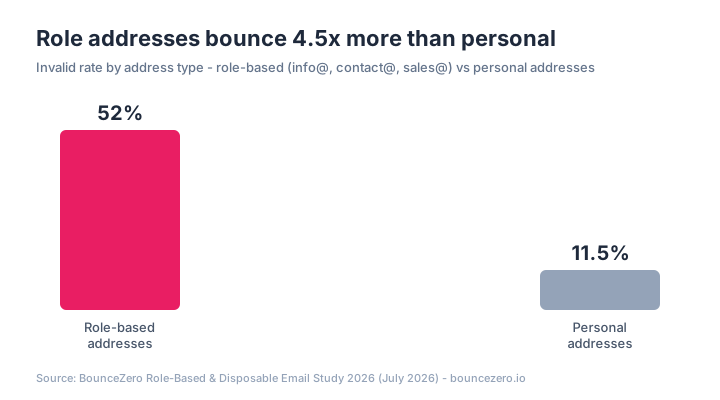
- - Role-based addresses bounced at 52.1% - versus 11.5% for personal addresses. That is 4.5× the invalid rate, the opposite of the usual "role-based mailboxes exist, they're just not worth mailing" wisdom.
- - The reason is composition: in outbound data, a role-based address is usually a list-vendor guess (
marketing@, contact@, hello@) made when the real person couldn't be found - and most of those guesses are wrong.
- - But role-based is not one thing.
contact@ validated at 3.3%, marketing@ at 9.3%, while support@ hit 45.0% and hr@ 57.1% - a 17× spread across role prefixes.
- - Disposable addresses are rare in B2B (0.035% of checks) but 94.8% invalid. One on your list is almost always a data-collection mistake, not a lead.
Role-based: the received wisdom is backwards for cold lists
The standard advice on role-based addresses - info@, sales@,
marketing@, the shared mailboxes not tied to one person - is that they exist
but shouldn't be mailed: higher complaint risk, no individual to build a relationship with. That
framing assumes the mailbox is real. In our data, drawn from outbound verification traffic, the
more urgent fact is that most role-based addresses on cold lists don't resolve at all.
Across 210,427 role-based checks, 52.1% came back invalid and only 13.5% valid.
Against the 11.5% invalid rate for the other ten million addresses, role-based bounces at
4.5 times the rate of a personal address. The explanation is not that shared
mailboxes have died en masse; it is that in an outbound corpus, a role-based address is usually
what a list vendor typed when it couldn't find the real person. "We don't have [email protected],
so let's try [email protected] and hope." Most of the time, hope is not a real mailbox.
Copy this stat: "Role-based addresses on cold lists bounced at 52% - 4.5× the rate
of personal addresses - because most are list-vendor guesses, not real shared mailboxes." -
BounceZero Research, Role-Based and Disposable Emails (bouncezero.io/role-based-disposable-email-study-2026)
This reframes what the "role-based" flag is worth. It is not primarily a mailability warning; on a
cold list it is a list-quality warning - a marker that this row was probably
guessed rather than sourced, and should be treated as high-risk until proven otherwise.
...but "role-based" is not one thing
Treating every role prefix identically would be its own mistake. Split role-based addresses by the
exact local-part and they span a 17× range in validity - the marketing-flavored guesses fail
almost completely, while operational mailboxes that companies actually staff resolve far more
often:
| Local-part |
Domains seen |
Valid |
contact@ | 13,968 | 3.3% |
marketing@ | 47,429 | 9.3% |
info@ | 45,721 | 13.4% |
hello@ | 24,786 | 15.0% |
office@ | 4,827 | 27.9% |
admin@ | 3,841 | 40.6% |
support@ | 1,575 | 45.0% |
hr@ | 438 | 57.1% |
The pattern is intuitive once you see it: the prefixes a vendor reaches for when guessing -
contact@, marketing@, hello@ - are exactly the ones that
fail, because they are aspirational rather than sourced. The prefixes companies genuinely operate
and monitor - support@, admin@, hr@ - resolve far more
often. A verifier that collapses all role-based into one "risky" bucket throws away that
seventeen-fold signal.
Disposable: rare, and almost always a mistake
Disposable addresses - throwaway domains like the ones people use to grab a lead magnet without
giving a real address - are vanishingly rare in B2B data: 0.035% of checks, about
one in three thousand. That scarcity is itself the finding: in an outbound corpus, hardly anyone is
mailing throwaways on purpose. When one does appear, it is nearly always dead -
94.8% of disposable addresses were invalid - because throwaway domains don't
maintain stable mailboxes.
The operational reading is simple and one-directional: a disposable address on a B2B list is
almost never a lead and almost always a collection error (a form submission gaming a signup, a
scrape that swept up junk). Unlike role-based, there is no nuance tier here - disposable is a clean
exclude.
What to do with this
Treat the two flags very differently. Disposable is a hard filter - drop them, and
audit where they entered your funnel. Role-based is a graded risk signal, not a
blanket exclude: a contact@ on a cold list is almost certainly a bad guess and should
be verified or dropped, while an hr@ or support@ you sourced deliberately
may be a legitimate, staffed mailbox worth keeping. Either way, the presence of many role-based
addresses on a list is a signal about how the list was built - the same composition story
that runs through our provider-gap
study: guessed rows cluster together, and they bounce together.
Methodology
Figures aggregate 10.25M verifications from the BounceZero network, February-July 2026. The
role-based and disposable flags are set by the verification pipeline (a curated role-prefix list
and a disposable-domain list, respectively); validity combines our verified and
likely-valid classifications. Per-prefix breakdowns are shown only for local-parts seen
across at least 50 distinct domains (our k-anonymity floor); no individual addresses enter the
analysis. Figures are frozen in the versioned snapshot Q3-2026-preview.
Limitations - read these before citing
The headline role-based invalid rate is a property of cold outbound lists, which
is what our corpus over-weights. On an opt-in list - where a subscriber deliberately entered
[email protected] - role-based addresses would resolve far more often, because
they were sourced rather than guessed. So "role-based bounces at 52%" is a statement about guessed
cold-list rows, not about shared mailboxes as a category; quote it with that scope. The disposable
flag depends on a maintained list of throwaway domains and will under-count newly-spun ones. And
the per-prefix table reflects which roles vendors guess versus which companies
staff in our data - a real pattern, but one that could shift with a different audience mix.
The finding we hold most firmly: on cold data, a role-based address is a list-quality
signal first and a mailability signal second - and disposable is a near-certain exclude.